Quality assurance in housebuilding has never been more demanding.
Modern residential developments involve dozens of specialist trades working across hundreds of plots, often within compressed programmes. At the same time, expectations around build quality, documentation and regulatory compliance continue to rise — driven by customer pressure, warranty requirements and legislative change.
When QA processes vary between trades, supervisors or sites, small inconsistencies compound quickly. A missed inspection, incomplete sign-off or unclear responsibility can cascade into recurring defects across multiple plots. By the time problems surface, rework is expensive and handovers are delayed.
Research published by PlanRadar suggests rework can account for between 5% and 10% of total project cost in construction. For housebuilders delivering at volume, that represents a significant and largely avoidable financial exposure.
Reducing that risk requires more than catching defects at the end of the build. It requires standardising quality assurance across every trade — consistently, at scale.
Why QA Breaks Down on Large Housing Developments
On a typical residential development, each plot moves through a sequence of trades: groundworks, brickwork, roofing, mechanical and electrical installation, drylining, fire stopping and internal finishes. Each stage involves inspections, approvals and documentation.
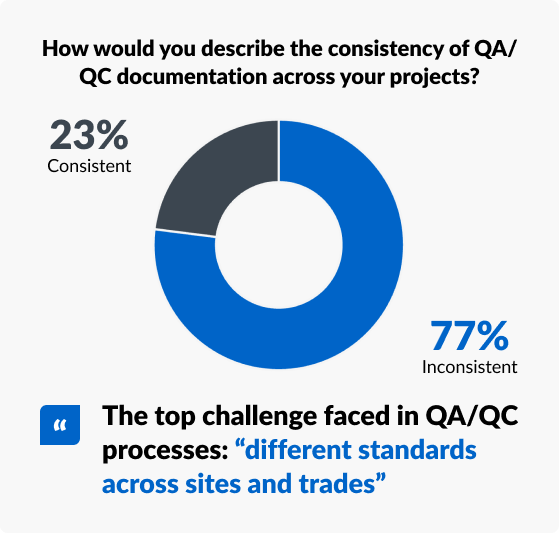
In practice, how that documentation happens varies enormously. Some supervisors record detailed inspection evidence with photographs and clear sign-offs. Others rely on informal checks or handwritten notes. Subcontractors operate to different standards, and information is often scattered across spreadsheets, email threads and paper forms.
The consequences are predictable. It becomes difficult to track whether inspections have been completed consistently across plots. Responsibility for quality issues becomes unclear. Recurring problems stay hidden until late in the programme, at which point they’re far costlier to resolve.
The UK-based Get It Right Initiative estimates that avoidable errors cost the construction industry billions each year, with most stemming from preventable mistakes and inconsistent processes. For housebuilders managing multiple developments simultaneously, the scale effect amplifies every gap.
What Standardised QA Actually Looks Like
Standardising QA doesn’t mean introducing bureaucratic processes that slow site teams down. It means creating a consistent framework for inspections and documentation — one that works across trades, supervisors and sites.
In practice, this means inspections follow structured templates, evidence is captured consistently, and responsibilities are clearly defined. When that framework exists, records become comparable across plots and developments, and patterns become visible.
That visibility is the real prize. Instead of discovering problems during final snagging, site teams can identify trends earlier in the build: if the same defect is appearing repeatedly at a particular stage, it can be addressed before it affects another twenty plots.
Standardised QA transforms quality management from a reactive activity into a preventative one.
The Myth That Better QA Slows Delivery
The most common objection to structured QA processes is that they add friction. In reality, the opposite is usually true: it’s poorly managed quality assurance that causes delays.
When inspections are recorded inconsistently, site teams spend hours reconstructing reports, chasing subcontractors for missing information or revisiting completed work to verify details that should have been captured at the time.
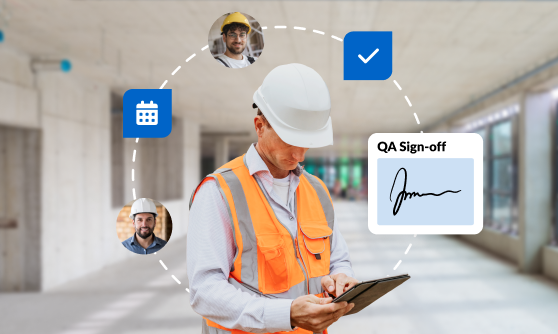
Capturing inspection data once, at the point of work, removes that administrative burden. Supervisors record inspections as they walk plots, attaching photographs and notes directly to the relevant build stage. Subcontractors receive clear, immediate instructions on what needs to be addressed. Progress is tracked in real time.
The result is less duplication, faster sign-off and stronger accountability across every trade.
QA and the Building Safety Act: Documentation Is Now Non-Negotiable
Quality assurance has also taken on a new legal dimension. The Building Safety Act has significantly increased the importance of maintaining accurate records throughout a building’s lifecycle — the so-called “golden thread” of information.
For housebuilders, this means inspections, evidence and sign-offs must be traceable and readily accessible — not just at handover, but at any point during or after construction.
If QA documentation is scattered across paper forms, emails and spreadsheets, assembling compliant records becomes a time-consuming and error-prone process. Standardised digital QA systems address this by creating structured audit trails automatically — built up incrementally as inspections are carried out, rather than reconstructed under pressure at the end.
From QA Data to Continuous Improvement
There’s a longer-term opportunity here that many housebuilders are only beginning to realise. When inspection data is structured consistently across sites, it becomes genuinely useful intelligence.
Technical teams can identify recurring issues linked to specific trades, build stages or materials. Regional managers can compare quality performance across sites. Directors gain visibility into systemic risks — before they become systemic costs.
This is what separates organisations that manage quality reactively from those that improve it structurally. The data is available for every development. The question is whether it’s being captured in a way that makes it usable.
How Digital Tools Support Standardisation at Scale
As residential developments grow in scale and complexity, digital tools have become central to how leading housebuilders manage quality assurance.
Platforms such as PlanRadar allow construction teams to create structured inspection templates, capture photographic evidence directly on site and assign actions to subcontractors in real time. Because inspections are recorded during site walks rather than retrospectively, reporting is faster and documentation more reliable.
For technical teams and senior management, the benefit extends beyond individual inspections. A connected QA platform provides a live overview of quality performance across projects — making it possible to identify risks earlier, allocate resources more effectively and build a defensible compliance record as a by-product of normal site operations.
Quality at Scale Is a Process Problem (and a Process Solution)
Quality issues in housebuilding rarely stem from one major failure. They emerge from small inconsistencies, repeated across dozens or hundreds of plots, that no one is in a position to see clearly.
Standardising QA processes across trades addresses that problem at its root. Consistent inspection frameworks, clear documentation requirements and better visibility of quality data allow housebuilders to reduce rework, improve build consistency and strengthen their compliance position, without adding friction to delivery.
In an industry facing tighter regulation, rising customer expectations and increasing cost pressure, structured quality assurance is no longer a back-office process. It’s a core operational capability, and the housebuilders who treat it as one will be better placed to deliver reliably at scale.
Try PlanRadar for free for 30 days and see how easy it can be to start standardising your QA.