TL;DR: How much does rework cost in construction?
Rework typically costs 5–10% of a construction project’s total value, and as much as 20% on poorly controlled projects. Even at the lower end, that is enough to erase most of a contractor’s margin on a typical job.
Cost of Rework in Construction Projects
Academic and industry research consistently shows that rework represents one of the most significant hidden costs in construction. Across project types and regions, rework accounts for 1–20% of total project cost, with most studies clustering between 4–10%. The Construction Industry Institute (CII) and multiple peer-reviewed studies confirm that even modest percentages translate to billions in lost project value globally.
The table below summarizes findings from multiple construction rework studies on cost percentages published between 1991 and 2026.
| Rework Cost (% of Total Project Cost) | Project Type / Scope | Source |
| 10–20% | General | Cnudde (1991) |
| 10% | Civic / General | Nylén (1996) |
| 2.77% (avg.) | General | Love & Li (2000) |
| 5.0% (avg.) | General | Hwang et al. (2009) |
| 5.06% (avg.) | General | Oyewobi et al. (2011) |
| 2–20% (range) | General | CII (2011) |
| 6.44% (avg.) | General | McDonald (2013) |
| 4.9% | General | Dougherty & Hughes (2014) |
| 4.95% (avg.) | Residential | Liu et al. (2018) |
| 0.39% (mean) | General (production phase only) | Love et al. (2019) |
| 0.81% (avg.) | General | Singh et al. (2022) |
| 11 % | General | PlanRadar (2023 |
| 5–10% | Residential | Mahamid (2024) |
| 0.38% precompletion; 0.76% incl. post-completion (actual measured) | General / contractor field data | Love (2026), ASCE J. Constr. Eng. Manage. |
| 10–25% (change-driven overruns, per overrunning project) | Commercial / multi-unit residential | PlanRadar (2026) |
Key takeaways:
1️⃣ Since the 1990s, the cost of rework as a percentage of total project cost has declined from double-digit figures to around 5-8% — a shift largely attributed to the adoption of digital QA/QC systems, improved communication tools, and better project controls.
2️⃣ Even at the lower end of current estimates (~5% of total project cost), rework represents a significant profit risk — equivalent to several percentage points of contractor margin on a typical project.
Causes for Rework in Construction Projects
Academic studies consistently show that design-related errors and deviations account for 1–9% of total project cost. These include design omissions, inaccurate drawings, and late design changes.
| Rework cost due to design-related errors (% of Total Project Cost) | Project Type / Scope | Source |
| 6.9% | General | Cnudde (1991) |
| 9.5% | Industrial | Burati et al. (1992) |
| 1.8% | General | Hwang et al. (2009) |
| 1.5% | General | Dougherty & Hughes (2014) |
Construction-related causes — such as workmanship errors, deviations from plans, and improper supervision — contribute a smaller but still significant share, up to 3% of total project cost in industrial and building projects.
| Rework cost due to construction-related causes (% of Total Project Cost) | Project Type / Scope | Source |
| 3.3% | General | Cnudde (1991) |
| 2.5% | Industrial | Burati et al. (1992) |
| 0.3% | General | Dougherty & Hughes (2014) |
Key takeaways:
 Since the 1990s, rework as a share of total project cost has declined from double-digit figures toward roughly 5–8%, a shift largely attributed to digital QA/QC systems, better communication tools, and tighter project controls.
 Even at the lower end of current estimates (around 5% of total project cost), rework is a significant profit risk, equivalent to several points of contractor margin on a typical project.
 The headline percentages may understate the problem. A 2026 ASCE study by Peter Love found that contractors under-reported their actual field rework costs by around 300%: teams believed rework was negligible, but once precompletion and post-completion corrections were captured, real costs ran from a fraction of a percent up to 7.3% of contract value on individual projects. The lesson is that what isn’t measured tends to be absorbed quietly into the budget.
 Mid-project change is a major driver of these costs. On a typical mid-sized commercial or multi-unit residential project, changes alone add 10–25% of project value in unplanned cost (about $1 million to $2.5 million on a $10 million build), and two in three professionals surveyed say changes drive budget overruns on many or most of their projects (PlanRadar, 2026).
Causes of Rework in Construction Projects
Design-related errors and deviations account for 1–9% of total project cost. These include design omissions, inaccurate drawings, and late design changes.
Construction-related causes, such as workmanship errors, deviations from plans, and improper supervision, contribute a smaller but still significant share, up to 3% of total project cost in industrial and building projects.
| Rework cost due to construction-related causes (% of Total Project Cost) | Project Type / Scope | Source |
| 3.3% | General | Cnudde (1991) |
| 2.5% | Industrial | Burati et al. (1992) |
| 0.3% | General | Dougherty & Hughes (2014) |
Key takeaways:
Since the early 1990s, the cost impact of design-related errors has fallen from around 9% to just 1–2% of total project cost, reflecting the positive effects of digitisation, BIM adoption, and improved design coordination workflows across the construction sector. Nonetheless, strengthening early-stage coordination and design verification offers a high leverage for reducing rework.
Because of the scarcity of empirical studies, the financial impact of construction-related errors on project costs cannot yet be quantified with confidence.
Underlying Information-Related Factors Driving Rework
While design and construction errors are the most visible causes of rework, research shows these problems often originate from deeper information-related issues. Studies find that miscommunication causes 26% of all rework, while bad or inaccurate information causes 14–22%.
| Underlying Factor | Share of Total Rework (%) | Project Type / Scope | Source |
| Miscommunication | 26% | General | PlanGrid & FMI (2018) |
| Bad / inaccurate data or information | 22% | General | PlanGrid & FMI (2018) |
| Bad data | 14% | General | Autodesk & FMI (2021) |
This is borne out by the 2026 changes data: nearly 8 in 10 professionals surveyed report that at least half of their project documentation lives in unconsolidated channels such as email threads, text messages, and phone calls. When the record is scattered, errors slip through and the work to fix them lands later, when it is most expensive to undo.
The Impact of QA/QC on Rework
PlanRadar’s Construction QA/QC Impact Report 2025 provides direct evidence that consistent quality management reduces rework and protects margins. Across 811 professionals in 13 countries, the data shows rework is a management and process issue, closely tied to the consistency of QA/QC practice.
💰 Nearly two in three companies (56%) with consistent QA/QC processes keep rework costs under 5% of project budget, compared with only one in three (37%) without standards.
⚠️ Firms without QA/QC standards are 21% more likely to experience avoidable rework, 50% more likely to face warranty exposure, and 23% more likely to have subcontractor disputes.
📈 Consistency also correlates with profitability: companies with strong QA/QC standards are 28% more likely to achieve profit margins above 3%.
 The cost is often invisible without standards: 43% of firms with no set QA/QC standard have no idea what rework is costing them, nearly twice the rate of firms with consistent QA/QC. This is the same under-reporting the Love (2026) study measured: what isn’t tracked gets absorbed.
Reducing rework is also where the industry expects the gains to come from. Nearly half of professionals (48%) name reducing rework and cost as their top QA/QC priority, ahead of every other goal. Consistent QA/QC is one of the most effective ways to deliver it, bringing down both direct costs and project delays.
How PlanRadar Helps Reduce Rework with Consistent QA/QC
PlanRadar is a platform for digital documentation, communication, and reporting in construction and real estate projects. Most rework starts one of two ways: a quality check done too late, or a change that loses its owner before it reaches the site. PlanRadar closes both gaps, standardizing how teams capture and verify quality and how they manage RFIs and change orders, so issues surface before the next trade builds over them, disputes are avoided, and margins are protected.
Quality assurance that catches issues early
✅ Flexible QA/QC workflows: Create digital checklists, inspection forms, and approval steps tailored to each project and trade, so every process follows the same standard, every time.
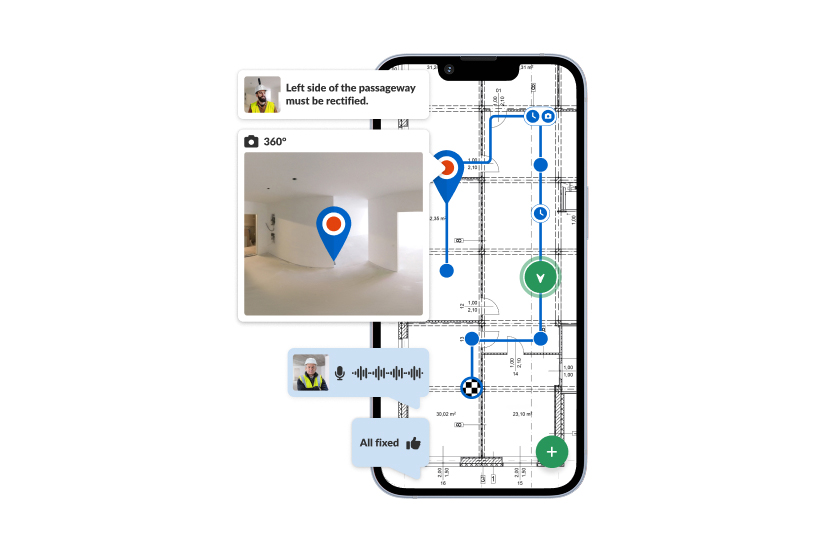
✅ Capture pinned to the plan: Log inspections against the exact location on the drawing with photos attached, and add a full SiteView 360° record of each build stage so reviewers can sign off decisively without a return visit.
✅ Clear subcontractor accountability: Centralize all QA/QC data, comments, and sign-offs in one standardized format so every contractor knows what’s required, with no missed checks or duplicated work, and it’s free for subcontractors to use.
✅ Real-time oversight: Dashboards show what’s done and what’s overdue across every trade, so nothing is quietly skipped and late checks are caught before they turn into rework.
Project management that keeps change under control
✅ Structured RFIs and change orders: Raise, assign, and answer every request in one standard format straight from site, each with an owner, a due date, and automatic notifications, so information reaches the site before work proceeds on the wrong assumption..
✅ Live visibility of impact: Project managers see in real time where each request sits and the cumulative cost of changes against what’s approved, and every action is timestamped as a ready-made audit trail if a dispute arises.
✅ Simple to adopt: Clear subcontractor accountability: with an intuitive mobile app that works online or offline, teams start capturing QA/QC and change data within minutes; everything syncs automatically when connectivity returns, with no complex setup or long training sessions..
The result shows up in the numbers: 90% of PlanRadar customers report a reduction in rework.
👉 👉 Ready to reduce rework and improve quality consistency? Book a free demo today and see how PlanRadar supports systematic QA/QC and change management on every project.
FAQ
How do you reduce or avoid rework in construction?
Reduce rework by putting consistent quality assurance and project management processes in place: run quality checks at the point of work rather than at the end, standardize how every subcontractor records inspections, and keep RFIs and change orders owned and traceable through approval. Companies with consistent QA/QC keep rework under 5% of budget far more often than those without. See our full guide, How to Avoid Rework in Construction, for a data-driven walkthrough.
What are the main causes of rework in construction?
The most visible causes are design-related errors (omissions, inaccurate drawings, late design changes), which account for 1–9% of project cost, and construction-related errors such as poor workmanship and deviations from plans. Underneath these, research attributes about 26% of all rework to miscommunication and 14–22% to bad or inaccurate information. Unmanaged mid-project changes and scattered documentation are common triggers. The data tables above break each cause down by study.
How does AI reduce rework in construction?
AI reduces rework by catching problems earlier and removing the information gaps that cause it. Applied to project records, AI can scan a construction contract to confirm which clauses apply to a change, flag missing notification obligations, and automate documentation so requests don’t stall or get lost. In PlanRadar’s 2026 survey, two thirds of teams using AI-enabled tools saved at least two hours per week per project on admin and reported fewer delays from unclear requests. Learn more about PlanRadar’s AI capabilities.