The Future Homes Standard (FHS) is no longer a distant regulatory horizon — it’s live, and it’s reshaping how new homes in England are designed, built, and handed over. For UK housebuilders, the shift is about more than adding heat pumps and solar panels. It’s a fundamental change in how quality is specified, evidenced and verified, from the first design decision through to post-completion testing.
The stakes are high. Under the FHS, new homes must produce around 75–80% fewer carbon emissions than those built under earlier Building Regulations. But emissions targets alone don’t tell the full story. The bigger challenge for most housebuilders is closing the long-standing gap between how homes are designed to perform on paper and how they actually perform once they’re occupied. That challenge is now measurable, traceable and — increasingly — commercially unavoidable.
This blog looks at what FHS compliance really demands on site, where the biggest quality risks sit, and how housebuilders are using digital quality management to move from blueprint to verified compliance without slowing down delivery.
What the Future Homes Standard really changes
Much of the early FHS conversation focused on the visible changes: no more gas boilers in new homes, heat pumps as the default, solar PV on the roof, better insulation in the walls. All of that is true, but it understates the scale of the shift.
The less visible — and arguably more demanding — change is around evidence. Under the FHS, the spotlight falls on fabric performance, airtightness, thermal bridging at junctions, correct ventilation commissioning, and documented as-built verification. Building Control scrutiny is tightening. Warranty providers and assessors expect testing, inspections and documentation to be scheduled as part of the build programme, not bolted on at the end. And with EPC reform and smart metering on the way, homeowners themselves will soon have practical tools to test whether the home they bought actually performs as promised.
In other words, the performance gap (the difference between “as-designed” and “as-built”) is about to become far more visible. Housebuilders who cannot evidence their quality at every stage will feel the consequences on customer satisfaction scores, warranty claims, and brand reputation.
Where quality breaks down on FHS sites
For most housebuilders, the technical specifications of the FHS aren’t the hardest part. The hardest part is delivering those specifications consistently across hundreds of plots, dozens of subcontractors, and a tightly compressed programme.
A few recurring risk points stand out.
Fabric-first decisions being diluted on site. The design team might specify a 150mm cavity, a particular window U-value, specific junction details and a challenging airtightness target. But somewhere between architect’s drawing and bricklayer’s trowel, those details can drift — a substituted product here, a rushed detail there. Each small compromise erodes as-built performance.
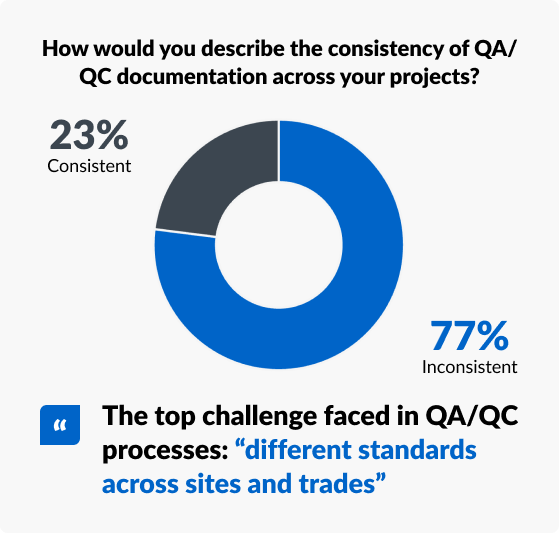
Inconsistent inspections across trades and plots. When one site supervisor uses a paper checklist, another uses a spreadsheet, and a third relies on memory, there is no common record of what was inspected, when, and by whom. Recurring defects at specific build stages go unnoticed until final snagging.
Ventilation and heat pump commissioning. Low-carbon heating systems are only as good as their commissioning. Incorrectly balanced MVHR systems, poorly sited heat pumps, or missing controls information at handover all contribute to the performance gap and all sit firmly in quality-assurance territory.
Handover documentation. Under the FHS, evidence matters. Photographic records, airtightness test results, commissioning certificates, installer competence records, customer guides for controls and filters; all of this needs to be captured, organised and retrievable. For many housebuilders, this is where paper processes visibly break down.
Building a digital quality trail
The housebuilders moving most confidently through the FHS transition have one thing in common: they’ve stopped relying on scattered paper, ad-hoc spreadsheets and email chains to manage quality. Instead, they’re building a single digital quality trail that starts with the approved drawings and ends with a fully evidenced handover pack.
That trail typically runs across four stages.
1. Locking down the design intent
FHS compliance begins long before anyone breaks ground. Key decisions — envelope details, thermal bridging strategy, ventilation approach, heating solution per house type — need to be fixed early and communicated clearly to every trade. A cloud-based platform that ties specifications, drawings and BIM models to the plots they apply to means that when a site supervisor opens their tablet, they are always working from the current, approved version, not last month’s revision.
2. Standardising inspections across trades
Standardisation is the foundation of scalable quality assurance. Instead of each supervisor running their own version of a checklist, housebuilders are rolling out templated inspection workflows — one for each trade, each build stage, and each house type. Every inspection is logged against the correct plot on the correct drawing, with photos, notes and assigned actions attached. Non-conformances become tickets, not sticky notes, and they can be assigned, tracked and closed out with a full audit trail.
The benefit isn’t just documentation. It’s data. When the same defect appears on the same detail across multiple plots, the pattern is visible immediately — not at final snagging.
3. Evidencing as-built performance
The FHS puts as-built verification at the centre of compliance. That means airtightness tests, ventilation commissioning records, insulation photography at key stages, and clear evidence that what was installed matches what was specified.
Capturing this digitally — tied to the plot, the drawing and the build stage — transforms the evidence burden from a scramble at handover into a by-product of normal site activity. When the assessor, warranty provider or Building Control inspector asks for evidence, the answer is already in the system.
4. Delivering a clean handover
At handover, the customer should receive a home that performs as designed — and the documentation to prove it. Controls manuals, filter locations, commissioning certificates, warranty information, and clear guidance on living in a low-carbon home all need to be organised and accessible. A digital handover pack, generated from the same platform that managed the build, closes the loop between compliance and customer experience.
How PlanRadar supports housebuilders under the FHS
PlanRadar gives housebuilders a single platform to manage quality across every plot, every trade and every stage of the build. Site teams work from up-to-date drawings and BIM models on mobile devices, log inspections against templated checklists, capture photographic and commissioning evidence tied to the plot, and generate handover packs that satisfy Building Control, warranty providers and customers alike.
For housebuilders navigating the Future Homes Standard, that means fewer gaps between design and delivery, less time spent chasing documentation, and a clear, defensible record of compliance at every stage.
Ready to see how it works on your sites? Book a demo or start a free trial today.